

BY JOSEPH LISTER NYARINGO
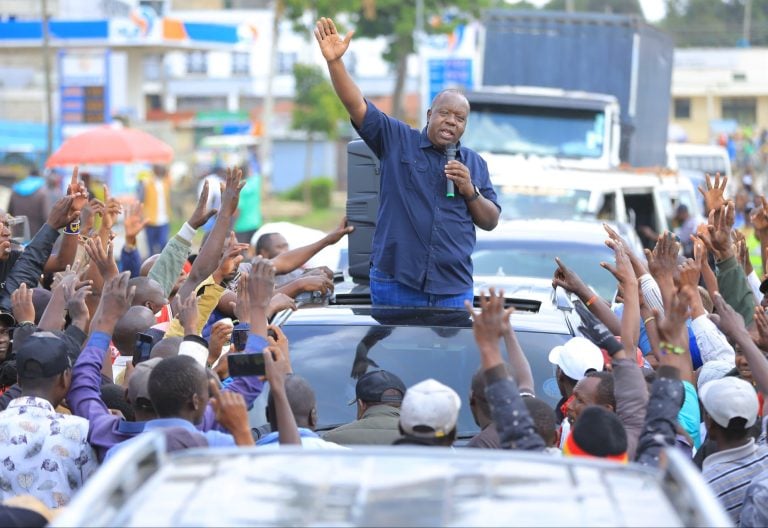
History is repeating itself in Gusiland.
In 2002, the late Simeon Nyachae turned the region into a Ford People zone. All 10 parliamentary seats went his way. Today, Former Cabinet Secretary Fred Matiang’i is reviving that playbook.
His decision to challenge President William Ruto’s 2027 re-election bid has set Gusiland alight.
The numbers are different now. Despite Nyachae’s decades of clout, cash and connections, he lost to Mwai Kibaki. Backed by retired President Uhuru Kenyatta, Dr. Matiang’i’s meteoric rise has put him in the league of other presidential candidates like Kalonzo Musyoka, George Natembeya, Martha Karua, and Eugene Wamalwa.
The stakes are higher than in 2002 when Gusiland had 10 constituencies. Today, Kisii has nine and Nyamira four.
For many, Matiang’i embodies decisive leadership — a no-nonsense administrator with a record of delivering where others failed. The huge crowds in the recent homecoming signalled a Nyachae-style political wave in Gusiland, reinforcing his grassroots strength and sending a clear message: His political stock is rising well beyond the region.
For many Abagusii voters, Matiang’i’s potential presidential candidacy embodies long-awaited national recognition.
Yet there is talk he might drift towards Ruto if he misses the Opposition ticket. South Mugirango MP Sylvanus Osoro and Governor Simba Arati’s camp await that outcome, ready to declare: “We told you so.” Ruto’s handlers in Gusiland, Osoro, and UDA treasurer Japheth Nyakundi [Kitutu Chache North MP] and the latest entrant, Arati, deputy party leader of ODM, are in a state of quandary about ‘the Matiang’i wave,’ which is making it harder for them to sell Ruto’s agenda.
The three pro-Ruto leaders, Arati, Osoro and Nyakundi, have two wars to fight: Their own re-election and that of Ruto.
For Arati, his biggest vulnerability is fiscal accountability. Residents want answers on nearly Sh40 billion from Nairobi over four years. Critics say service delivery is where he falls short. Service delivery is Arati’s Achilles heel.
Four years in, voters can’t name a flagship project under his watch. The county referral hospital and sub-county facilities keep running out of drugs and personnel.
Arati rode youthful energy to victory in 2022, beating veterans Ongore, Ongeri, and Machogu as young voters demanded change. That enthusiasm has faded.
Voters say former CS Education Machogu higher of Kisii Senator Richard Onyonka doesn’t run, noting that retired governor James Ongwae wasn’t young but left a respected legacy.
Former Governor Ongwae, ex-Woman Representative Janet Ong’era and others argue that Arati’s combative style clashes with Gusii’s old-school politics of accommodation and peacefulness. Matiang’i’s rise has put Arati on the edge.
He could be the first casualty of this realignment. But don’t write him off yet. He’s from Bobasi, a constituency with the highest number of registered voters, where he is called “our son” by locals. Clan identity in Gusiland moves votes.
Still, the 2022 coalition that backed Arati is dominated by Onyonka, Kitutu Chache South MP Anthony Kibagendi, and several ODM MPs and MCAs have jumped ship.
Ironically, his loudest defenders now are UDA figures he once bashed. However, he remains a tough campaigner — well-funded, combative, and sharp at grassroots mobilisation.
Dennis Makori Sonko is a serious threat to Osoro’s re-election bid. He faces the gigantic task of burning the candle at both ends: Defending his parliamentary seat while spearheading Ruto’s re-election.
Critics label Osoro divisive and self-serving, accusing him of gate-keeping access to the President and sidelining Gusii leaders. Detractors argue he prioritises consolidating national clout over the region’s collective interests.
Onyonka and Machogu remain Arati’s principal adversaries. Onyonka’s camp touts his formidable record on oversight and accountability as evidence that he is executive material. Detractors counter that he is a parliamentarian, not a chief executive.
His Abagetutu lineage may also prove an electoral liability, with a vocal cohort insisting the governorship must rotate among clans.
Machogu commands sway in the vote-rich Nyambari clan. Age is a liability; yet his proximity to Matiang’i, now widely regarded as the region’s kingmaker, could fortify his candidacy.
(Mr Nyaringo is a governance advocate in Washington, US. All rights reserved to original post of this article)
