

BY LEVIN OPIYO
Omar Al-Bashir maintained a very tight grip on Sudan. The key features of his rule were a highly centralised state, oppression, and big man syndrome.
With his unexpected overthrow and without an authoritative figure to take over, the highly centralised state inherited from him quickly disintegrated as factionalism became prominent.
In essence, Sudan, as a unitary state, stopped existing at that point, and restoring it is going to be a toll order because of the competing interests.
Lieutenant General Mohamed Hamdan Dagalo of the RSF and General Abdel al-Fatah al-Burhan of the SAF tried to work together to run the country, but it didn’t take long before they parted ways and started fighting each other for power. It would, therefore, not be far-fetched to observe that Sudan is headed the Libyan way
The collapse of Gaddafi’s highly centralised government paved the way for a very disintegrated state with multiple centres of power controlled by rival political and military factions.
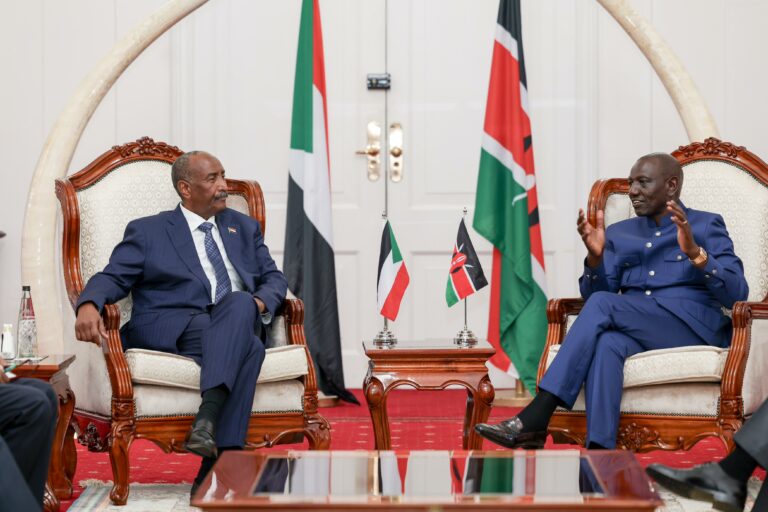
There’s the Tripoli-based Government of National Accord , and the Tobruk-based Government of National Stability. The meeting of Sudan’s RFS and its affiliates in Nairobi points to this direction.
While it is true that the situation in the Sudan is out of domestic factors, there’s no doubt that the conflict is being prolonged by foreign players with vested interests.
The RSF is being supported by UAE, Israel, Libya, Ethiopia, CAR, and Kenya, and there are also whispers about discreet support from America and countries in Europe. In fact, the RFS has been seen using Israel made weapons.
The SAF, on the other hand, has the support of Saudi Arabia, Turkey, Qatar, Egypt, Djibouti, and Iran.
Even though Russia is a key player in the current situation, it has been shifting goal posts depending on which side of its bread is buttered. Initially, Russia, with its Wagner group of mercenaries, supported RFS with military weapons and training in exchange for gold, which is found in areas controlled by the RFS.
The deal saw Russia secure gold mining concession in the Blue Nile and Darfur regions.
However, in the recent past, Russia, driven by its ambition to establish a naval base in the Red Sea, has been shifting towards the SAF. Just last week, Russian officials met the SAF leaders to renew an agreement that would see Russia provide arms to SAF in exchange for a naval base at the coast.
While powerful countries such as Russia, UAE, and Israel, Saudi Arabia are exploiting the conflict to their own benefits, what could be said about African countries such as Kenyan that are becoming entangled in the conflict? Are they conduits for smuggling Sudanese minerals such gold or puppets acting for external powers? On whose directive did it agree to host the RSF? Kenya being the West’s blue eyed boy, there’s no way it could host the RSF, without the influence of Western powers.
