BY MANUEL ODENY
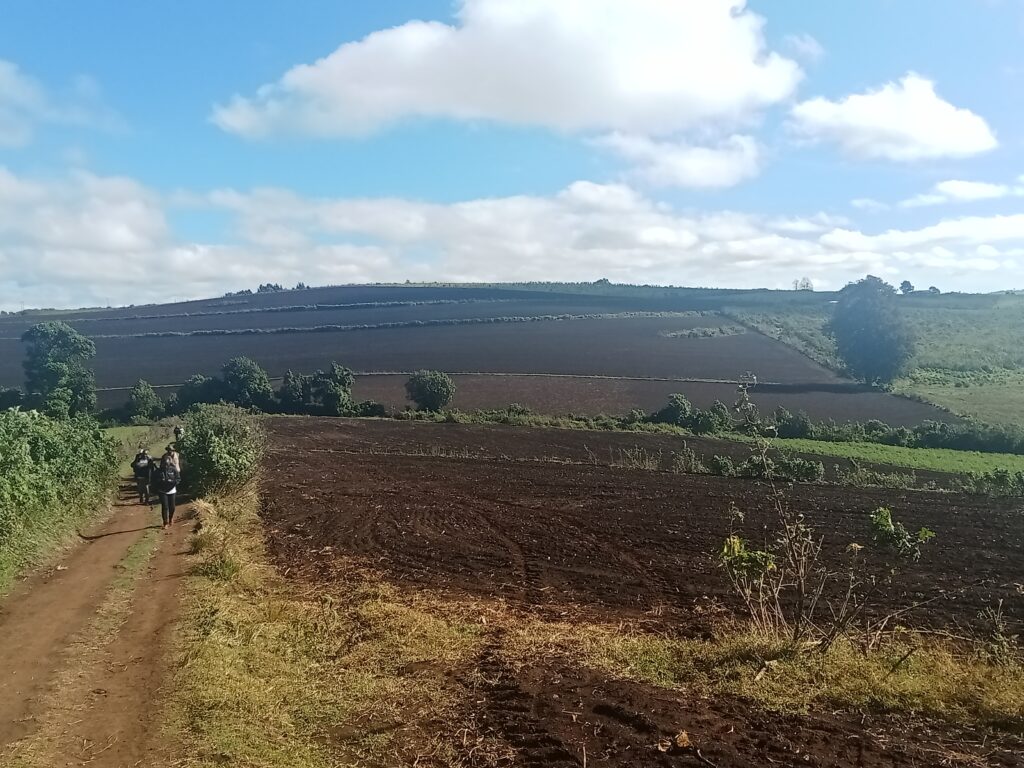
Narok North region in Narok county, Kenya cuts the picturesque of an idyllic African rural home: gentle rolling hills, perfectly tilled land and simple huts masking regions most affected by global climate change vulgarities.
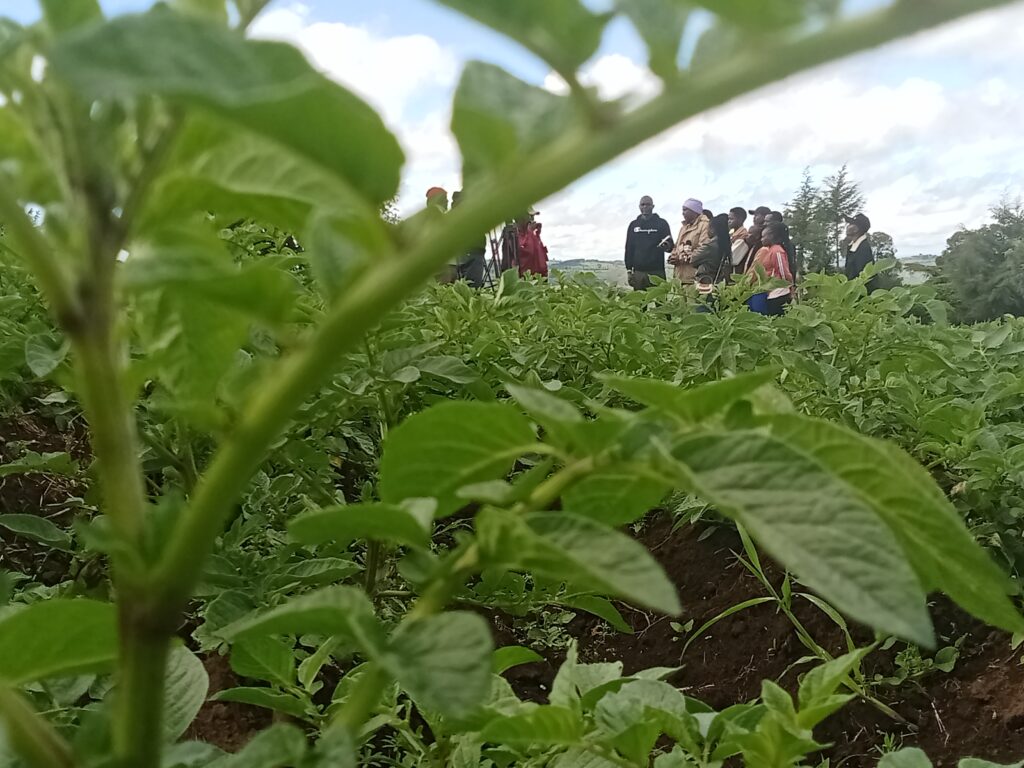
And at an edge of a hill, Ernest Thome a farmer is surrounded by more than a dozen Agriculture students from local learning institutions for an internship in his 50 acres land which has been turned into a model for climate smart farming.
The group is working on a new patch of land for avocado planting, which will be key in increasing forest since depleted from the region, add value to the farm and also gain from carbon credit trading.
“When I started farming here thirty years ago these bare hills were lush with vegetation, we open up farms for Irish potatoes until we were faced with erratic rain and drought patterns,” Toome explains.
Thome’s farm has been used as a model demonstration farm for climate smart farming and how African farmers can best help tackle climate change.
“We have young African farmers, we are here to train them and pass knowledge on how best to restore our environment and tackle climate change since African farmers face the biggest brunt of the global warming,” he added.
Thome has planted over 300 avocadoes which he is currently intercropping with Irish potatoes and tomatoes before they mature.
“We have taken up avocadoes because we are increasing forest cover while adding value to the products and still be able to get carbon credit payment, it is a win-win situation,” he said.
Toome is also using no tillage method to avoid upsetting ecosystem, strictly uses compost manure from a biogas digester which is feed from waste from his dairy cows, merino sheep and kienyeji chicken.
“We also bring back traditional trees like mutamayu which have been lost through charcoal and sculpture work, we will pass this knowledge to next generation,” Thome explains.
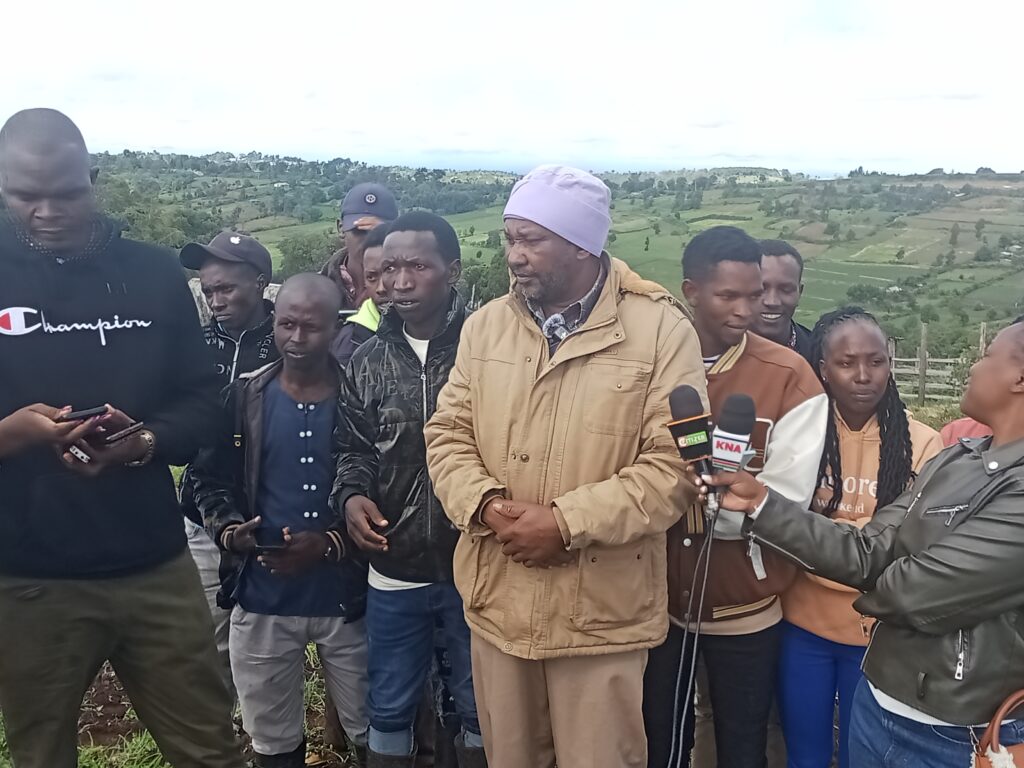
Joel Dikir and Everline Punyo, students of Sustainable Agriculture at Rift Valley Institute of Technology said the biggest challenge is that farming has changed into a global affair with effects of global warming and restoring fertility being a challenge for current generation.
At Thome’s homestead, his wife Beatrice shakes a biogas digester before adding one part of cow dung to two parts of water in it.
“I have stopped using firewood which saves trees and this biogas also easily warms my chicks for brooding and house,” Beatrice said.
Earlier she had picked and distributed five barrels of liquid fertilisers to avocado seedlings, a major step in revitalizing the farm.
Thome’s farm is part of the the Restore Africa Programme (RESAf) which is being rolled out in Kenya, Malawi, and Uganda which banks on nature to restor land and remove carbon from environment.
Through Farmer Managed Natural Regeneration (FMNR) the plan in Kenya aims to increase resilience and productivity of socio-ecological systems through restoration of 250,000 hectares of degraded land across five counties – Elgeyo Marakwet, Kilifi, Kwale, Migori, and Narok.
Dr. Faith Muniale an expert from World Vision, on of implementing partner said the project plans to improve the livelihoods of 250,000 smallholder farmers and pastoralists (including women and youth) by 2052.
Other partners in the Kenyan project are Africa Harvest Biotech Foundation International, Self Help Africa, Green Belt Movement, Justdiggit, and the Center for International Forestry Research and World Agroforestry (CIFOR-ICRAF).
“We work on looking for seedlings which are high quality and at subsidized prices for farmer and push through agro-forestry value addition and climate smart farming,” Muniale said.
She said they picked hass avocadoes which after two years can give over a thousand fruit in a year and can support other crops through intercropping while it can support bee keeping.
“We need to build on eco-system which supports nature while we also put farmers through carbon credit earning, which is an icing in the cake,’ she said.
Kenya’s Climate Change Act and its subsequent amendments, along with the Climate Change (Carbon Markets) Regulations, 2024 ha enable farmers like Thome to benefit from carbon trading.
Carbon credits are earned through projects that avoid or remove greenhouse gas emissions, and each credit represents one fewer tonne of carbon dioxide equivalent (CO2e) in the atmosphere.
“In Kenya we work reforestation, sustainable grassland management, and energy-efficient cookstove initiatives which makes such a farm to be a place to push through the agenda across farms,” she said.